Reclaim 50–150 GB of Hidden Developer Caches on Your Mac
CodeCleaner is a native macOS app that finds and safely removes Xcode DerivedData, iOS Simulators, node_modules, Docker images, Colima VMs, Rust/Cargo, Python virtualenvs, Gradle builds, Go modules, Homebrew bottles, and IDE caches — six specialized tools built for developers who need their disk space back.
Requires macOS 14 Sonoma or later. Native on Apple Silicon & Intel.
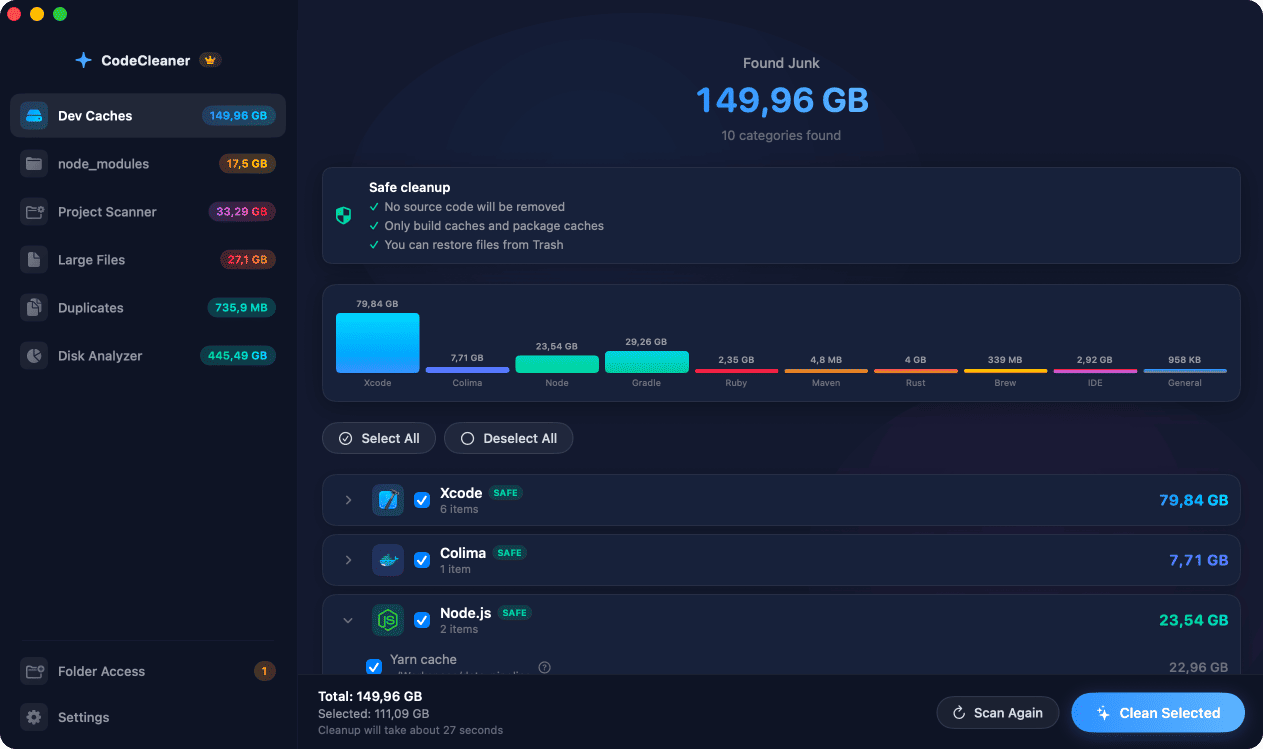
Your development tools are silently eating your disk space
Xcode, Docker, Colima, Node.js, Rust, Python, Gradle, Go, Ruby, Flutter, Homebrew, and your IDE create massive hidden caches and build artifacts that grow every day — consuming 50–150 GB that you could reclaim right now.
Xcode Caches
DerivedData, Archives, DeviceSupport, iOS/watchOS Simulators, SPM cache
~25–60 GB
Docker & Colima
Unused images, stopped containers, dangling volumes, build cache, Lima VMs
~10–30 GB
Node.js Caches
npm, pnpm, yarn global caches + scattered node_modules
~5–15 GB
Rust / Cargo
Cargo registry, git checkouts, Rustup toolchains
~3–10 GB
Python
pip, Poetry, Conda caches, virtualenvs, pyenv, pipx, Ruff/mypy
~2–8 GB
Android / Gradle
Gradle caches, daemon, wrapper, AVD images, Android Studio logs
~5–12 GB
Homebrew
Downloaded bottles, formula cache, outdated packages
~2–5 GB
IDE Caches
VS Code, Cursor, JetBrains — extensions, workspace storage, logs
~2–5 GB
Go, Ruby, Flutter & More
Go modules, gem cache, pub cache, Maven repo, diagnostic reports
~2–8 GB
Six specialized tools, one native macOS app
Purpose-built for developers who use Xcode, Node.js, Rust, Python, Docker, Go, Gradle, and more. Each module targets a different source of wasted disk space — from global caches to per-project build artifacts to forgotten large files and duplicates.
Dev Caches Cleanup
Automatically detect and safely remove developer-specific caches that generic cleaners miss. CodeCleaner intelligently detects which tools you have installed — Xcode, Docker, Node.js, Rust, Python, Go, Ruby, Flutter, Gradle, Homebrew, and more — and only scans relevant cache paths for speed.
- Xcode DerivedData, Simulators & SPM cache
- Docker & Colima images, volumes, and VMs
- npm / yarn / pnpm global caches
- Rust Cargo registry & Rustup toolchains
- Python pip, Poetry, Conda & virtualenvs
- Gradle, Android build cache & AVD images
- Go modules & build cache
- Ruby gems, CocoaPods, Homebrew bottles
- VS Code, Cursor & JetBrains IDE caches
node_modules Scanner
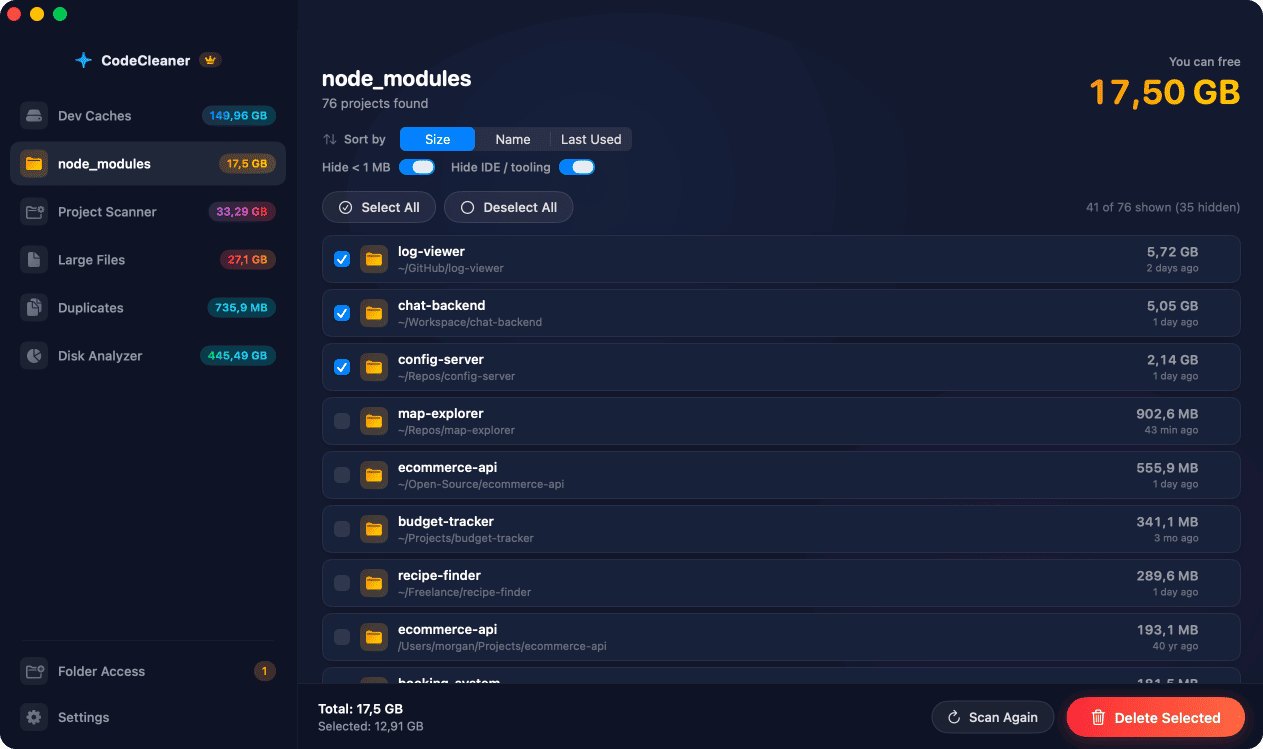
Find every node_modules folder scattered across your entire filesystem. JavaScript and TypeScript developers accumulate dozens of projects over time, each with a full copy of its dependencies. This scanner locates them all, shows their sizes, and lets you clean up in bulk.
- Full-disk recursive node_modules search
- Sort by size, name, or last used date
- Filter out folders under 1 MB
- Hide IDE & tooling directories
- Regenerate with npm/yarn/pnpm install
- Bulk select and delete
Project Build Artifact Scanner
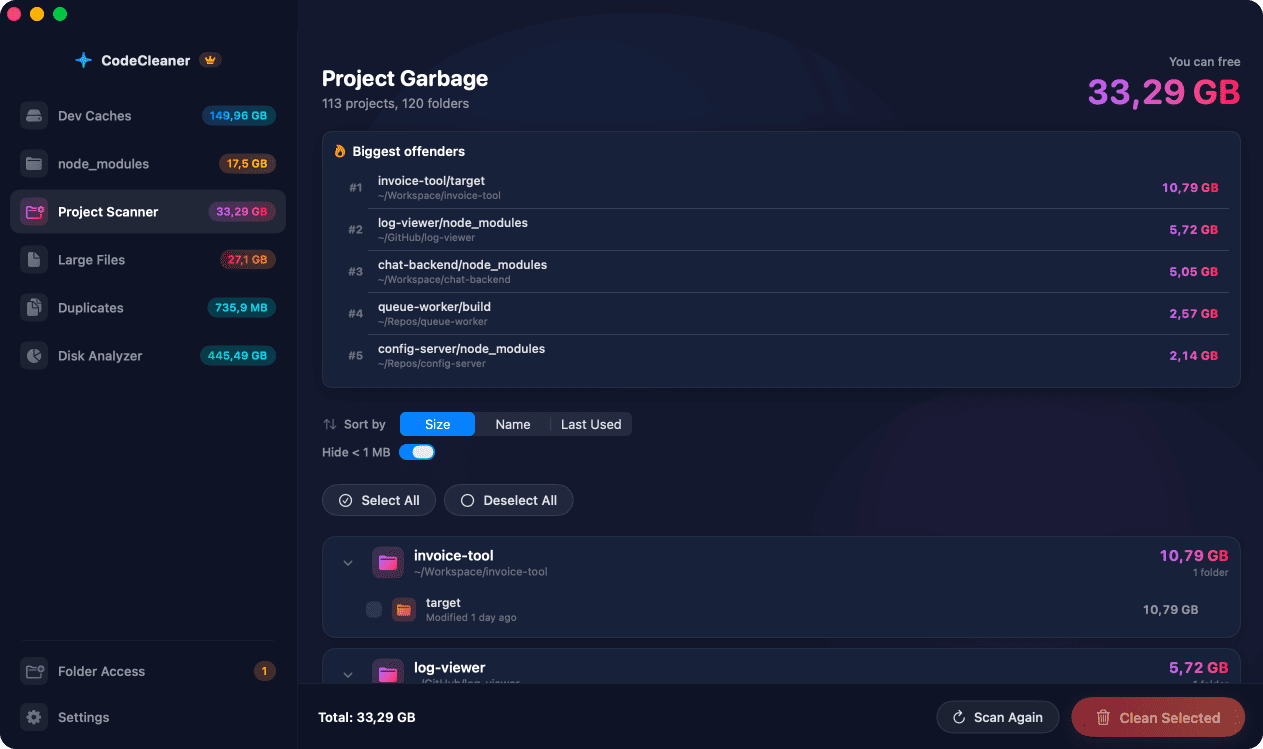
Detect large build output folders inside your projects that can be safely regenerated. Finds node_modules, target (Rust/Java), build, dist, .next, .nuxt, .cache, Python venvs, and __pycache__ across all your project directories.
- node_modules in JS/TS projects
- target in Rust & Java/Gradle projects
- build / dist output folders
- .next, .nuxt, and .cache directories
- Python venv & __pycache__ folders
- Biggest offenders ranking
Large File Finder
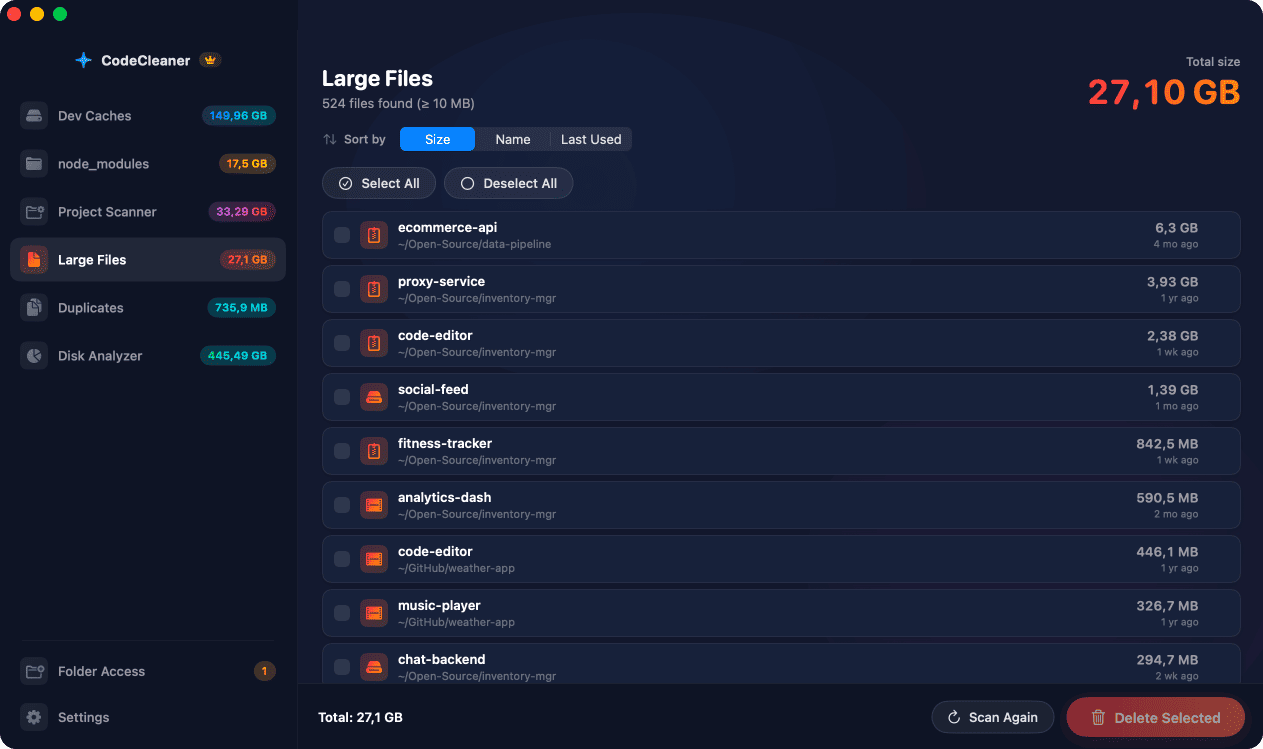
Scan your home directory for large files that may be forgotten disk images, database dumps, video recordings, or old archives. Configurable size threshold (default 100 MB) with smart filtering that skips dependency and build trees to avoid noise.
- Configurable minimum file size
- Skips build & dependency trees
- Finds forgotten disk images & dumps
- Works within granted folder access
- Quick size-sorted results
- Safe review before deletion
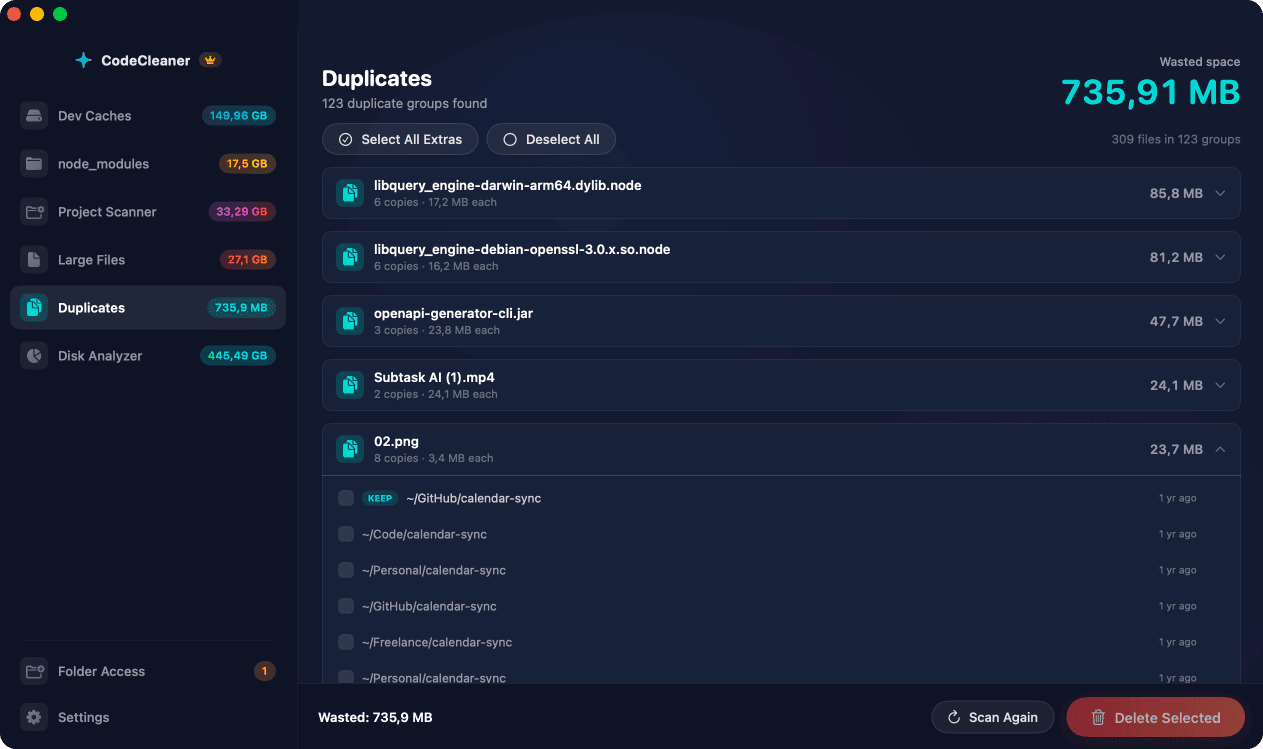
Duplicate File Detector
Find duplicate files consuming wasted disk space using fast CryptoKit hashing. Focuses on files larger than 1 MB and uses partial hashing for efficiency. Smart skip lists automatically exclude node_modules, build outputs, caches, and .git directories.
- CryptoKit-based file hashing
- Partial hash for large files
- Groups duplicates by content
- Calculates wasted space per group
- Skips build & dependency folders
- Select which copies to remove
Disk Space Analyzer
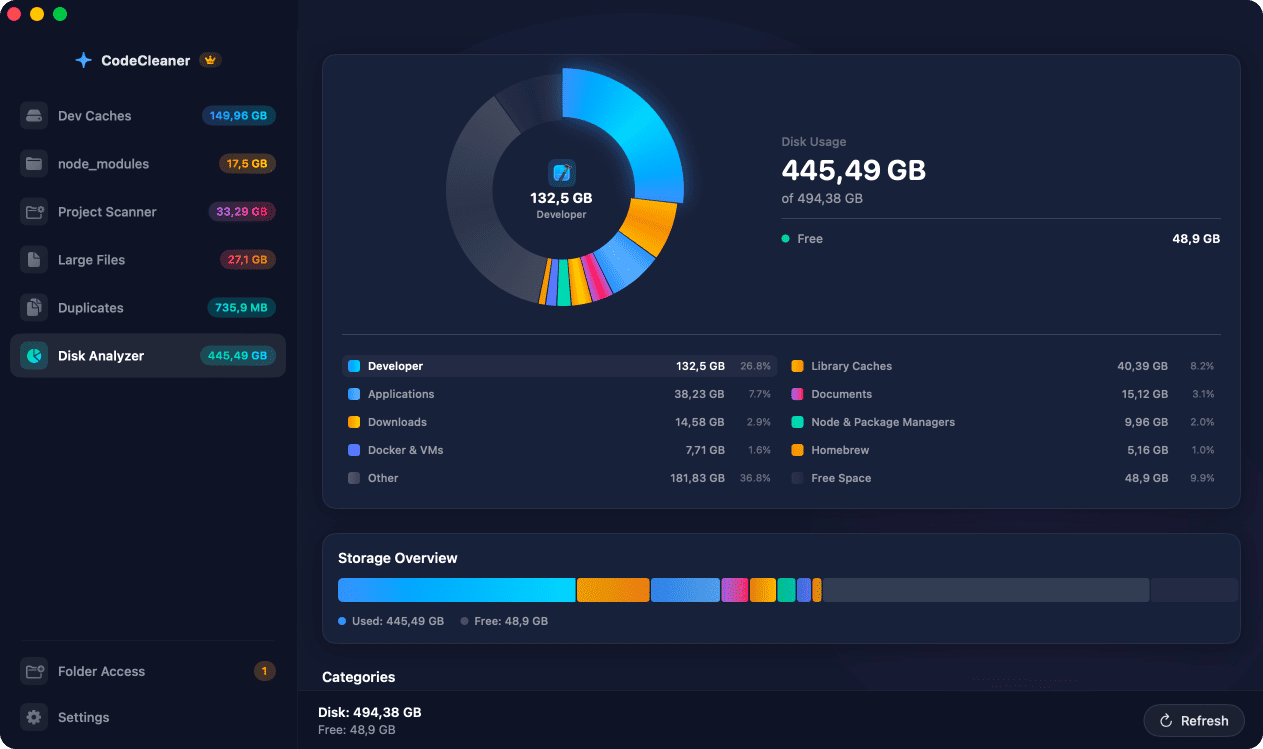
Visualize your entire disk usage with a developer-focused breakdown. See exactly how much space Xcode, Docker, Node packages, Python environments, Homebrew, Applications, Documents, and system caches consume — with capacity, used, free, and purgeable space at a glance.
- Interactive donut chart overview
- Developer-focused category breakdown
- Docker, Node, Homebrew sizing
- Capacity / used / free / purgeable
- Parallel scanning with timeouts
- Reveal any folder in Finder
Three steps to reclaim your disk space
No configuration needed. CodeCleaner auto-detects your development toolchain, scans the right paths in parallel, and lets you review every item before anything is deleted. Safe by design.
Scan your Mac
CodeCleaner auto-detects which developer tools you have installed — Xcode, Node.js, Rust, Python, Docker, Colima, Go, Gradle, Ruby, Flutter, Homebrew, and popular IDEs — then scans only the relevant cache paths using low-level filesystem APIs for maximum speed.
Review what was found
Browse a detailed breakdown grouped by tool and category. See the exact size of each cache, build artifact, or large file. Select or deselect individual items — you always have full control over what gets removed.
Clean safely with one click
Hit "Clean Selected" and CodeCleaner removes only the items you approved. Whitelist-based deletion ensures your source code is never touched — only regenerable build caches, package artifacts, and temporary files are removed.
See CodeCleaner in action
A native macOS app built with SwiftUI, featuring a dark, developer-friendly interface. Six dedicated modules to find and reclaim every type of developer disk waste — from Xcode caches to duplicate files.
Why developers need a dedicated macOS disk cleaner
A comprehensive guide to understanding what fills your disk and how to reclaim space without breaking your development environment. CodeCleaner supports 15+ developer tools and frameworks.
How to Clean Xcode DerivedData, Simulators, and Archives on Mac
Xcode's DerivedData folder at ~/Library/Developer/Xcode/DerivedData stores build products, indexes, and logs for every project you have ever opened. Over time it can grow to 20–60 GB. Old iOS, watchOS, and tvOS Simulator runtimes in ~/Library/Developer/CoreSimulator accumulate with every Xcode update, adding another 10–30 GB. Archives from past App Store submissions, device support files for every iPhone and iPad you have connected, and Swift Package Manager caches add even more. CodeCleaner scans all of these locations, shows you the size of each DerivedData subfolder, simulator runtime, and archive, and lets you selectively remove stale entries without affecting your active builds. This is the single largest source of reclaimable space for most iOS and macOS developers.
Clearing npm, yarn, and pnpm Caches and node_modules on macOS
JavaScript and TypeScript developers accumulate massive package caches over time. The npm cache at ~/.npm, yarn cache at ~/Library/Caches/Yarn, and pnpm store at ~/.pnpm-store can each grow to several gigabytes. On top of that, every project's node_modules folder contains a full copy of its dependencies — and if you have dozens of projects, that adds up to tens of gigabytes fast. CodeCleaner includes a dedicated node_modules scanner that finds every instance across your entire filesystem, lets you sort by size or last-used date, filter out small or tooling directories, and remove them safely in bulk. You can always regenerate them with a single npm install, yarn install, or pnpm install when you return to a project. The separate Dev Caches module handles the global npm, yarn, and pnpm caches.
Cleaning Rust Cargo Registry, Git Checkouts, and Rustup Toolchains
Rust developers accumulate crate downloads in ~/.cargo/registry, git checkouts in ~/.cargo/git, and multiple toolchain versions under ~/.rustup/toolchains. After months of development across multiple projects that pull in hundreds of crate dependencies, these directories can consume 3–10 GB or more. Each project also generates a target/ directory with compiled artifacts that can be several gigabytes per project. CodeCleaner detects your Rust installation, calculates the size of each cache component, and lets you clean the registry and git caches without removing your active toolchains. The Project Scanner module separately finds and sizes every target/ directory across your projects.
Removing Python pip Caches, Poetry Caches, Conda, and Virtualenvs on Mac
Python's package ecosystem creates caches in ~/.cache/pip, ~/Library/Caches/pypoetry, and Conda/Miniconda/Anaconda installations. Each virtualenv duplicates the Python interpreter and all installed packages, so a handful of projects can easily consume several gigabytes. Add pyenv installations, pipx environments, and tool caches from Ruff, mypy, and pre-commit, and the total grows further. CodeCleaner identifies all of these cache locations — pip, Poetry, Conda, pyenv, pipx, Ruff, mypy, and pre-commit — shows you the total size, and lets you reclaim space from stale downloads and unused virtualenvs while keeping your active environments intact.
Docker and Colima Disk Cleanup for macOS Developers
Docker Desktop and Colima store images, containers, volumes, and build cache in disk images that grow over time but rarely shrink on their own. Unused images from old projects, stopped containers, dangling volumes, and accumulated build cache layers can consume 10–30 GB. Colima additionally creates Lima VMs under ~/.colima and ~/.lima that can consume 5–20 GB each. CodeCleaner integrates with the Docker CLI to show exactly how much space images, containers, volumes, and build cache consume, and can prune them safely using official docker prune commands — not by deleting files directly. For Colima users, it also detects and measures the Lima VM disk footprint so you can reclaim space from unused VMs.
Cleaning Gradle, Android Build Cache, and Android Studio on Mac
Android and Java developers accumulate significant disk usage from Gradle caches at ~/.gradle/caches, daemon files, wrapper distributions, and the Android build-cache. Android Virtual Device (AVD) images for testing on different screen sizes and API levels add several more gigabytes. Android Studio itself generates caches and logs under ~/Library/Caches/Google and ~/Library/Logs/Google that grow with every project. CodeCleaner detects your Android/Gradle installation, scans all of these locations, and lets you selectively clean caches, old daemon files, and unused wrapper distributions without affecting your current builds.
Cleaning Go Modules, Ruby Gems, Flutter Pub Cache, and Maven Repository
Beyond the major toolchains, CodeCleaner also handles Go module cache at ~/go/pkg/mod and build cache at ~/.cache/go-build, Ruby gem installations at ~/.gem plus rbenv and RVM paths, CocoaPods cache, Flutter's Dart pub cache at ~/.pub-cache, and Maven's local repository at ~/.m2/repository. Each of these grows silently over months of development. CodeCleaner's intelligent tool detection means it only scans for tools you actually have installed, so the scan stays fast and relevant regardless of how many languages you use.
Cleaning VS Code, Cursor, and JetBrains IDE Caches on macOS
Modern IDEs generate substantial cache data. VS Code stores extensions, workspace storage, and logs that can grow to several gigabytes. Cursor — the AI-powered code editor built on VS Code — creates its own separate cache, extensions, and workspace storage directories. JetBrains products like IntelliJ IDEA, WebStorm, PyCharm, and Android Studio each maintain their own caches and log directories under ~/Library. CodeCleaner detects all installed IDEs and shows you exactly how much cache, extension, workspace storage, and log data each one has accumulated, letting you clean them without affecting your settings or project configurations.
Cleaning Project Build Artifacts: node_modules, target, build, dist, .next
Every project on your Mac leaves behind build output folders — node_modules in JavaScript and TypeScript projects, target in Rust and Java, build and dist in various frameworks, .next in Next.js apps, .nuxt in Nuxt.js apps, .cache in bundler tools, and Python virtual environment folders like venv and .venv. CodeCleaner's Project Scanner walks your filesystem looking for project root markers (package.json, Cargo.toml, build.gradle, Xcode project files, etc.) and identifies all build artifact folders within each project. It ranks them by size with a "biggest offenders" list and lets you remove them in bulk. Since these folders are always regenerated by your build tool, deleting them is completely safe and can free tens of gigabytes.
Finding Large Files and Duplicate Files on Your Developer Mac
Beyond caches and build artifacts, developers often accumulate large files — disk images, database dumps, video recordings, old archives, and VM snapshots — that are forgotten in project directories or Downloads. CodeCleaner's Large File Finder scans your accessible directories for files above a configurable threshold (default 100 MB) while smartly skipping dependency and build trees to avoid noise. The Duplicate File Detector uses CryptoKit hashing to find identical files larger than 1 MB, employing partial hashing for efficiency and extensive skip lists to ignore node_modules, caches, and .git directories. Together, these tools help you find wasted space that isn't related to any specific development tool.
How Much Disk Space Can a macOS Developer Reclaim?
Between Xcode caches (25–60 GB), Docker and Colima (10–30 GB), Node.js caches and node_modules (5–15 GB), Rust/Cargo (3–10 GB), Python environments (2–8 GB), Gradle/Android (5–12 GB), Go/Ruby/Flutter/Maven (2–8 GB), Homebrew (2–5 GB), IDE caches (2–5 GB), and system diagnostics (1–3 GB), a typical developer's Mac accumulates 50–150 GB of reclaimable space within a year. Generic disk cleaners like CleanMyMac or DaisyDisk don't understand developer toolchains — they miss DerivedData, ignore node_modules, can't identify stale simulator runtimes, and don't know how to prune Docker images or clean Cargo registries. CodeCleaner is purpose-built for developers. It understands the structure of Xcode projects, Node.js workspaces, Rust crates, Python environments, Gradle builds, Go modules, Homebrew downloads, Docker installations, and IDE data directories. Whether you are an iOS developer running low on disk space, a full-stack engineer with dozens of Node.js projects, or a polyglot developer using Rust, Python, and Go on the same machine, CodeCleaner finds and removes the developer junk that other tools overlook.
How CodeCleaner Keeps Your Source Code and Data Safe
Safety is a core design principle of CodeCleaner. The app uses whitelist-based deletion — only paths on a known-safe list of cache and build artifact locations can be removed. Source code files are never targeted. Docker resources are cleaned via official docker prune CLI commands, not by deleting files directly. The node_modules scanner validates that directories actually end with node_modules before allowing removal. The Project Scanner only deletes recognized build artifact folder names (node_modules, target, build, dist, .next, .cache, etc.) or verified Python virtual environments. You always see a complete list of what will be deleted and can select or deselect individual items before any cleanup runs. Everything runs locally on your Mac — no data is uploaded, no account is required, and no telemetry is collected.
CodeCleaner vs CleanMyMac and generic disk cleaners
Generic cleaners like CleanMyMac and DaisyDisk weren't built for developers. CodeCleaner understands your entire toolchain — from Xcode DerivedData to Cargo registries to Docker images to Colima VMs.
| Feature | CodeCleaner | Generic Cleaners |
|---|---|---|
| Xcode DerivedData, Simulators & Archives cleanup | ||
| npm / yarn / pnpm cache cleanup | ||
| Dedicated node_modules scanner with sort & filter | ||
| Docker & Colima image/volume/VM cleanup | ||
| Rust Cargo registry & Rustup toolchain cleanup | ||
| Python pip, Poetry, Conda & virtualenv cleanup | ||
| Gradle, Android build cache & AVD cleanup | ||
| Go module & build cache cleanup | ||
| Ruby, Flutter, Maven cache cleanup | ||
| VS Code, Cursor & JetBrains IDE cache cleanup | ||
| Project build artifact scanner (target, dist, .next) | ||
| Large file finder with smart filtering | ||
| Duplicate file detector with CryptoKit hashing | ||
| Developer-focused disk space analyzer | ||
| Auto-detects installed developer tools | ||
| Whitelist-based safe deletion (source code never touched) | ||
| 100% local — no data leaves your Mac | ||
| Native macOS app (SwiftUI, Apple Silicon optimized) |
Reclaim 50–150 GB of developer caches today
Download CodeCleaner and free your Mac from Xcode DerivedData, node_modules, Docker images, Colima VMs, Rust/Cargo caches, Python virtualenvs, Gradle builds, Go modules, Homebrew bottles, and IDE caches — all in one native macOS app. Free scan, no account required.
Requires macOS 14 Sonoma or later. Native on Apple Silicon & Intel.